Injured on the Job at the Port of Corpus Christi: What Are Your Legal Options?
The Port of Corpus Christi and the refineries, petrochemical plants, and terminals that surround it are among the largest employers in the Coastal Bend — and also some of the most dangerous workplaces in the region. Heavy equipment, hazardous chemicals, confined spaces, and constant vessel and rail traffic create injury risks that are simply different in scale and type from a typical workplace accident. If you’ve been hurt on the job at the Port or a related facility, the legal options available to you depend heavily on a few key factors that don’t apply to most workplace injuries.
Why Port and Petrochemical Jobs Carry Unique Legal Considerations
A construction site or warehouse injury usually involves one employer and a relatively straightforward set of legal questions. Port and petrochemical injuries are often more complicated, because a single facility can involve the property owner, the operating company, multiple contractors and subcontractors, equipment manufacturers, and — in many cases — maritime law, if the injury happens on or around a vessel or in connection with loading and unloading cargo. Untangling who’s actually responsible, and under which legal framework, is often the most important early step in one of these cases.
Texas’s Unique Workers’ Compensation System: Subscribers vs. Non-Subscribers
Texas is one of the only states in the country where workers’ compensation coverage is not mandatory for most private employers. Under Texas Labor Code § 406.002, employers can choose whether to “subscribe” to workers’ compensation insurance. If an employer is a subscriber, Texas Labor Code § 408.001 generally makes workers’ comp the exclusive remedy for a workplace injury — meaning an injured employee typically can’t sue their employer directly, except in narrow circumstances such as a death caused by the employer’s gross negligence or intentional act.
If Your Employer Doesn’t Carry Workers’ Comp
This is where Texas law creates a significant difference from most other states. If an employer is a non-subscriber — meaning they chose not to carry workers’ compensation coverage — an injured employee can generally sue that employer directly for negligence. And critically, Texas Labor Code § 406.033 strips non-subscriber employers of several defenses that would otherwise be available in an ordinary negligence case: the employer generally cannot argue that the employee’s own negligence contributed to the injury, that the employee assumed the risk by doing the job, or that a co-worker’s negligence (rather than the employer’s) caused the injury.
This combination — full access to a negligence lawsuit, without those traditional defenses — can make a non-subscriber claim significantly more favorable to an injured worker than a workers’ comp claim would be, though it also means there’s no guaranteed benefit the way workers’ comp provides regardless of fault. Many large port and petrochemical employers are subscribers, but contractors and subcontractors working at these facilities are not always, and determining your specific employer’s status — and the status of any other companies involved — is one of the first things that needs to happen after an injury.
Third-Party Claims: When Someone Other Than Your Employer Is Liable
Regardless of whether your own employer is a workers’ comp subscriber, you may have a separate claim against a third party whose negligence contributed to your injury — a different contractor on site, the owner or operator of the facility (if different from your employer), or the manufacturer of defective equipment or machinery. These third-party claims are common in port and petrochemical settings precisely because so many different companies operate in the same physical space at the same time. A crane operated by one company, maintained by another, on property owned by a third, with your employer as a fourth party present at the site, is a fairly typical scenario — and each of those relationships can create separate legal responsibilities.
Maritime Workers and the Longshore and Harbor Workers’ Compensation Act
If your work involves loading, unloading, repairing, or building vessels, or you work on the navigable waters or adjoining areas of the Port, your situation may be governed in whole or in part by the federal Longshore and Harbor Workers’ Compensation Act (LHWCA) rather than, or in addition to, Texas workers’ compensation law. The LHWCA provides its own system of benefits for maritime workers and has its own rules about coverage, benefit calculations, and the relationship between LHWCA benefits and any third-party claims. Whether the LHWCA applies depends on the nature of your work and where it’s performed — a question that requires careful evaluation given how the Port’s operations blend land-based and maritime work.
Workers who qualify as “seamen” under the Jones Act — generally those with a substantial connection to a vessel in navigation — fall under a different federal framework entirely, with its own negligence-based remedy against an employer. The line between a Jones Act seaman, an LHWCA-covered maritime worker, and a worker covered by ordinary Texas workers’ comp or non-subscriber rules isn’t always obvious from job title alone, and getting this classification right affects which laws, deadlines, and procedures apply to a claim.
Common Causes of Injury at Port and Petrochemical Facilities
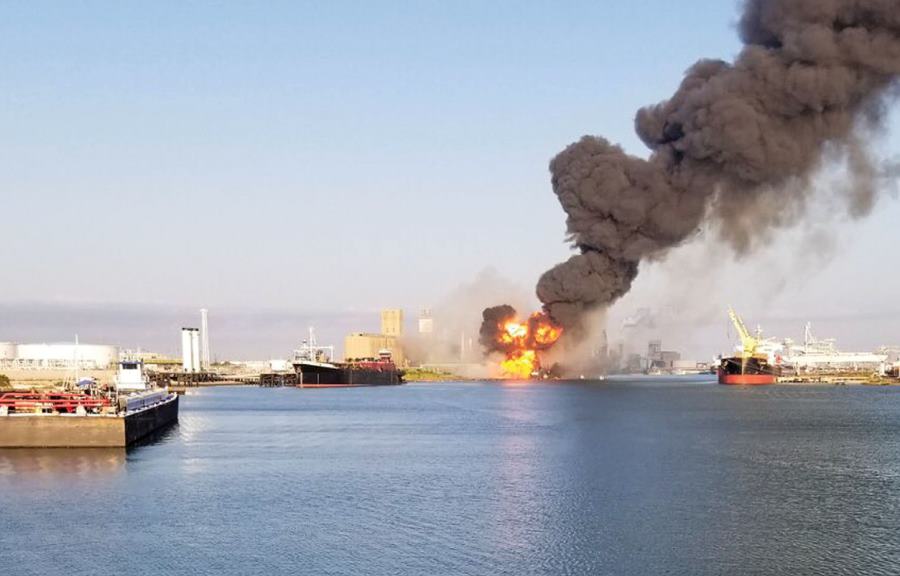
The injuries we see most often from this sector include chemical exposure and burns, explosions and fires, falls from elevated platforms and scaffolding, injuries from heavy machinery and conveyor systems, and crane and rigging accidents. Many of these incidents cause catastrophic injuries — severe burns, amputations, traumatic brain injuries, and fatalities — reflecting the scale of the equipment and materials involved compared to a typical workplace.
The Role of OSHA Violations in Your Claim
Facilities of this size and type are subject to extensive federal workplace safety regulations enforced by OSHA. While an OSHA citation isn’t automatically the same thing as proof of negligence in a civil claim, evidence that a facility violated specific safety standards — related to confined spaces, lockout/tagout procedures, fall protection, or hazardous chemical handling, for example — can be significant evidence supporting a negligence claim against an employer or another responsible party.
What to Do After a Workplace Injury
Report the injury through your employer’s normal process, but also document what happened independently if you’re able to — photos of the scene and equipment involved, names of witnesses, and your own account of events while it’s fresh. Seek medical treatment and follow through with recommended care. And because so much depends on your employer’s workers’ comp status, the involvement of other companies at the site, and whether maritime law applies, getting a personal injury attorney involved early — before statements are taken or assumptions are made about which system applies — matters significantly in these cases. Texas Civil Practice & Remedies Code § 16.003 generally gives two years to file a personal injury claim, but the practical investigation window is often much shorter.
If you or a family member has been injured working at the Port of Corpus Christi or a related facility, Barton & Associates offers free, confidential consultations to help you understand which legal framework applies to your situation. Call our Corpus Christi office at 361-800-6780.