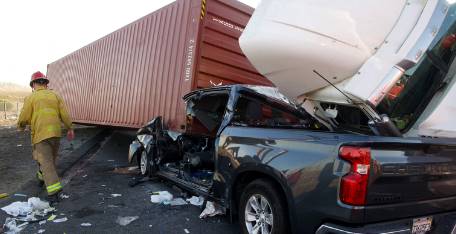
18-Wheeler Accident Claims in San Antonio: Federal Safety Rules, Evidence and Who Is Responsible
A collision with a tractor-trailer on I-35, I-10, Loop 410 or Loop 1604 is not handled like an ordinary car crash. The vehicle is regulated by federal safety rules, the driver usually works for a company, the company carries its own insurance and keeps records that can prove what went wrong, and Texas has special trial rules for commercial vehicle cases. An auto accident attorney in San Antonio can explain the rules that apply to every crash, and our general guide covers them. This page covers what changes when the other vehicle is an 18-wheeler.
It explains the federal rules that often matter, the records a trucking company must keep and for how long, who can be responsible, how a Texas court tries a commercial vehicle case, the insurance behind the truck and what to do in the first days.
Why a Truck Case Differs From a Car Case
Four things set a truck case apart.
- Federal regulation. Motor carriers and their drivers are subject to the Federal Motor Carrier Safety Regulations in Title 49 of the Code of Federal Regulations, and Texas authorizes its own commercial vehicle safety rules that follow the federal ones (Transportation Code Section 644.051). Which rules apply to a particular truck depends on the vehicle, the cargo and whether the carrier operates across state lines.
- More than one defendant. The driver is only one possible defendant. The carrier, the owner of the truck or trailer, a maintenance company, a shipper that loaded the cargo and a manufacturer can also be involved.
- Records the other side controls. Logs, maintenance files, hiring records and electronic data from the truck are held by the carrier, and some of it can be discarded on a schedule.
- Different trial rules. Chapter 72 of the Civil Practice and Remedies Code changes how a commercial vehicle collision case is tried in Texas, as explained below.
Federal Rules That Often Matter
The regulations give a lawyer a checklist for the crash. They do not decide a case by themselves, and a violation helps only if it is tied to how the crash happened. These are the rules we look at first.
- Hours of service. For a driver of a property-carrying commercial vehicle, the rules generally allow 11 hours of driving within a 14-hour window after 10 consecutive hours off duty, bar driving after more than 8 hours of driving without a 30-minute interruption, and limit on-duty time to 60 hours in 7 days or 70 hours in 8 days, with a restart after 34 or more consecutive hours off duty (49 C.F.R. Section 395.3). Exceptions, including short-haul exceptions, can change the limits for a given driver.
- Records of duty status. A motor carrier must keep a driver’s records of duty status and supporting documents for not less than six months (49 C.F.R. Section 395.8(k)). Many carriers record duty status on an electronic logging device.
- Maintenance. A carrier must keep inspection, repair and maintenance records where the vehicle is housed or maintained for one year and for six months after the vehicle leaves the carrier’s control (49 C.F.R. Section 396.3).
- Driver qualification. The driver qualification file holds the driver’s application, motor vehicle records, road test certificate or equivalent and medical certification, and it must be kept for as long as the driver is employed and three years afterward (49 C.F.R. Section 391.51).
- Texting. A commercial motor vehicle driver may not text while driving, and a carrier may not permit or require it (49 C.F.R. Section 392.80).
- Rear impact guards. Most trailers with a gross vehicle weight rating of 10,000 pounds or more built on or after January 26, 1998 must have a rear impact guard that meets federal standards, with exceptions for certain trailer types (49 C.F.R. Section 393.86). It matters in an underride crash.
Common Types of Truck Crashes
The size and weight of a loaded tractor-trailer produce collisions that a passenger car rarely causes.
- Underride. A car slides under the rear or side of a trailer.
- Jackknife. The trailer swings out of line with the cab and can block several lanes.
- Rollover. A truck tips over, often in a curve or an exit ramp.
- Wide turn. A truck swings wide to make a turn and strikes a vehicle beside it.
- Lost or shifted load. Cargo falls onto the road or shifts and upsets the truck.
- Tire or brake failure. A blown tire or failing brakes causes the driver to lose control.
Each type points to different evidence, from the trailer’s guard and lighting to the loading records and the maintenance file.
Who Can Be Responsible
The driver is responsible for his or her own negligence, and the company that employs the driver is generally responsible for what the driver does within the scope of the job. A claim may also reach a company that owned or leased the truck or trailer, a company that failed to maintain it, a shipper or loading company that secured the cargo improperly and a manufacturer of a defective part. The company may also be responsible for its own conduct, such as how it hired, trained, scheduled or maintained, and that is where its records matter.
How Texas Courts Try Commercial Vehicle Cases
Chapter 72 of the Civil Practice and Remedies Code includes rules that apply to a collision caused by the operation of a commercial motor vehicle, and it affects strategy from the start.
- Split trial. If a defendant moves for it by the deadline in the statute, the court must divide the trial in two. The first phase decides liability and compensatory damages, and the second decides liability and the amount of exemplary damages (Section 72.052).
- Employer stipulation. If the employer stipulates in time that the driver was its employee acting in the scope of employment, its liability for the driver’s ordinary negligence is based on respondeat superior, and in a split trial the claimant generally may not present first-phase evidence on ordinary negligence claims against the employer that depend on the driver’s negligence, such as negligent entrustment (Section 72.054). The statute lists driver and employer regulatory evidence that may still come in, such as licensing, out-of-service orders, medical certification and texting.
- What stays available. A claim that does not require proof of the driver’s negligence, such as negligent maintenance, and a claim for exemplary damages based on the company’s own conduct remain available (Section 72.054(f)).
- Regulatory violations. Evidence that a defendant failed to comply with a regulation is admissible in the first phase only if it tends to prove the failure was a proximate cause of the injury and the regulation is specific and governs the defendant (Section 72.053).
- Photographs and video. A court may not require expert testimony to admit a photograph or video of a vehicle or object in the collision, other than authentication, and an authenticated photograph or video is presumed admissible (Section 72.055).
These rules reward early evidence. Photographs and video of the vehicles and the scene are given a clear path into evidence, and the company’s own records decide whether its conduct can be tried.
Evidence to Preserve
The key evidence is in the carrier’s hands: the driver’s logs and supporting documents, the maintenance and inspection file, the driver qualification file, dispatch and communication records, and electronic data from the truck, such as engine control module data. Retention periods under the federal rules are minimums, and data from the truck can be lost if it is repaired or returned to service. A preservation letter should go to the carrier and its insurer promptly, and photographs of the truck, trailer, cab markings and USDOT number help identify who to send it to.
Insurance Behind the Truck
The federal financial responsibility rules set minimum insurance for motor carriers. For a for-hire carrier of nonhazardous property in interstate commerce with a vehicle of 10,001 pounds or more, the minimum is $750,000. Carriers hauling oil or certain hazardous materials must carry $1 million, and the minimum rises to $5 million for certain bulk hazardous cargo (49 C.F.R. Section 387.9). Those are minimums for interstate carriers, and a carrier’s actual coverage can be higher or can include excess policies. A carrier that operates only within Texas may be subject to different requirements, so ask for the policies early. Your own uninsured and underinsured motorist coverage can also matter, as the hub guide explains.
Damages, Fault and Deadlines
Damages in a truck case can include past and future medical care, lost earnings and earning capacity, pain, mental anguish, impairment and disfigurement, and, in a death case, losses to the family. Medical expenses are limited to the amount actually paid or incurred (Civil Practice and Remedies Code Section 41.0105). Exemplary damages require clear and convincing proof of fraud, malice or gross negligence (Section 41.003), and in a commercial vehicle case they are decided in the second phase of a split trial. A claimant found more than 50 percent responsible cannot recover, and a lower percentage reduces the award (Sections 33.001 and 33.012). A personal injury suit generally must be filed within two years (Section 16.003), and a claim against a government unit that owns the truck can require written notice much sooner.
What This Means for Your Bexar County Case
- Get medical care and follow the treatment plan, because the records link the injuries to the crash.
- Photograph the truck, the trailer, the company name, the USDOT number, the damage and the scene before they change.
- Get the crash report number and the driver’s and carrier’s names and insurance information.
- Do not give a recorded statement to the carrier’s insurer or sign a release.
- Ask a lawyer to send a preservation letter to the carrier and its insurer for logs, maintenance files, driver records and truck data.
- Keep a record of medical bills, missed work and daily limitations.
- Write down the deadlines that apply, including any notice period for a government-owned truck.
More About Truck and Serious Injury Claims
These guides cover related questions.
- catastrophic injury claims: brain, spinal cord and other life-changing injuries.
- wrongful death claims: who can bring a claim after a fatal crash.
- San Antonio car wreck attorney: claims against passenger-vehicle drivers.
- Texas personal injury statute of limitations: the filing deadlines in detail.
Why San Antonio Clients Choose Barton & Associates for Truck Accident Cases
Barton & Associates has tried Texas cases since 2001. The firm’s trial attorneys include Gary J. Barton, who founded the firm after serving as a Bexar County prosecutor and has tried more than 100 cases to a jury, and Jim Erickson, a senior trial attorney who has tried more than 250 cases to a jury verdict. A truck case turns on federal records, the trial rules in Chapter 72 and the insurance behind the carrier, so we start with what happened, which records exist and who the possible defendants are, and we tell you plainly what each choice risks. Where the facts call for it, we consult accident reconstructionists, physicians and economists or life-care planners.
We cannot promise a result. What we can do is tell you what the statutes require, what we recommend and what each choice risks. The first consultation is free and confidential. Our San Antonio office is at 115 Camaron Street, San Antonio, Texas 78205. You can get directions to our office before your visit. For the first meeting, bring what you can of the following, and call even if you cannot find everything.
- The crash report or report number, and any citation
- Photographs and video of the truck, the trailer, the scene and your injuries
- The truck driver’s name, the carrier’s name and USDOT number, and any insurance information
- Your insurance card and declarations page, and any letters or emails from an insurer
- Medical records, bills and explanation of benefits statements
- Repair estimates or the total-loss letter for your vehicle
- Pay stubs or an employer letter showing missed work
- A calendar of your key dates and deadlines
Frequently Asked Questions
Why is an 18-wheeler accident case different from a car accident case?
The truck is regulated by federal safety rules, the driver usually works for a company, the company keeps records that can show what went wrong and carries its own insurance, and Texas has special trial rules for commercial vehicle collisions in Chapter 72 of the Civil Practice and Remedies Code. A car case seldom involves any of those.
Who can be held responsible for a truck crash?
The driver, the motor carrier that employs the driver, the owner or lessor of the truck or trailer, a company responsible for maintenance, a shipper or loader that secured the cargo and a manufacturer of a defective part, depending on the facts. The company can be liable for the driver’s conduct within the scope of the job and for its own conduct, such as hiring, training or maintenance.
How many hours can a truck driver drive?
For a driver of a property-carrying commercial vehicle, the rules generally allow 11 hours of driving within a 14-hour window after 10 consecutive hours off duty, require a 30-minute break after 8 hours of driving and limit on-duty time to 60 hours in 7 days or 70 hours in 8 days (49 C.F.R. Section 395.3). Exceptions can apply.
How long must a trucking company keep logs and maintenance records?
Records of duty status and supporting documents must be kept for not less than six months (49 C.F.R. Section 395.8(k)). Maintenance records must be kept where the vehicle is housed or maintained for one year and for six months after it leaves the carrier’s control (Section 396.3), and the driver qualification file must be kept while the driver is employed and for three years afterward (Section 391.51). These are minimum periods, which is why a preservation letter should go out promptly.
What evidence should be preserved after a truck crash?
The driver’s logs and supporting documents, the maintenance and inspection file, the driver qualification file, dispatch and communication records, electronic data from the truck, and the truck and trailer themselves. Photographs and video from the scene and the USDOT number on the truck help identify the carrier.
What is a split trial in a Texas trucking case?
If a defendant moves for it on time, the court must divide a commercial vehicle collision trial into two phases. The first decides liability and compensatory damages, and the second decides liability and the amount of exemplary damages (Civil Practice and Remedies Code Section 72.052).
What happens if the trucking company admits the driver was its employee?
If the employer stipulates in time that the driver was its employee acting in the scope of employment, its liability for the driver’s ordinary negligence rests on respondeat superior, and in a split trial the claimant is limited in presenting first-phase evidence on claims such as negligent entrustment. Claims such as negligent maintenance and exemplary damages based on the company’s own conduct remain available (Section 72.054).
How much insurance does a trucking company carry?
The federal minimum for a for-hire carrier of nonhazardous property in interstate commerce with a vehicle of 10,001 pounds or more is $750,000, and it is $1 million for carriers hauling oil or certain hazardous materials and $5 million for certain bulk hazardous cargo (49 C.F.R. Section 387.9). Actual coverage can be higher, and rules for carriers operating only within Texas may differ, so the policies should be requested early.
What is an underride crash, and is the trailer required to have a guard?
An underride crash occurs when a passenger vehicle slides beneath a trailer. Most trailers with a gross vehicle weight rating of 10,000 pounds or more built on or after January 26, 1998 must have a rear impact guard that meets federal standards, with exceptions for certain trailer types (49 C.F.R. Section 393.86).
Can I recover punitive damages from a trucking company?
Exemplary damages require proof of fraud, malice or gross negligence by clear and convincing evidence (Civil Practice and Remedies Code Section 41.003), and they are capped by Section 41.008. A claim for them based on the company’s own conduct remains available in a commercial vehicle case and is decided in the second phase of a split trial (Sections 72.052 and 72.054). No lawyer can promise they will be awarded.
What if I was partly at fault for the crash?
A claimant found more than 50 percent responsible cannot recover damages, and a lower percentage reduces the award by that percentage (Civil Practice and Remedies Code Sections 33.001 and 33.012). Truck carriers and insurers often look for evidence that the other driver contributed, so photographs, video and the crash report matter.
How long do I have to file a lawsuit after a truck accident?
Generally two years from the date the claim accrues (Civil Practice and Remedies Code Section 16.003), and in a death case two years from the date of death. If the truck belongs to a city, county or other governmental unit, written notice can be required much sooner.
What should I bring to the first meeting about a truck accident?
Bring the crash report or report number, photographs and video, the driver’s and carrier’s names and USDOT number, your insurance information, letters from any insurer, medical records and bills, proof of missed work and a calendar of key dates. Call even if some records are missing.
Talk With a San Antonio 18-Wheeler Accident Attorney
Evidence in a truck case is held by the company and can be lost, and the insurer will already be building its file. Speak with a San Antonio car accident attorney at Barton & Associates before you give a statement or sign anything.
Call our San Antonio office at 210-500-0000 or complete the online Free Consultation form to schedule a confidential meeting about your truck accident claim. The office is at 115 Camaron Street, San Antonio, Texas 78205.
Main Category: Personal Injury
Practice Area Category: Motor Vehicle Accidents
Barton & Associates, Attorneys at Law
115 Camaron St, San Antonio, TX 78205
Office: 210-500-0000