Divorce Mistakes in Texas: Pro Se Divorce (DIY Divorce), Can You Do It Yourself?
Going through a divorce is one of the most emotionally and legally complex experiences a person can face. When finances are tight or the relationship seems straightforward, many Texans consider handling their divorce without an attorney — a process legally known as pro se divorce, and commonly called a DIY divorce. The appeal is understandable: save money, avoid lawyers, and move on with your life.
But the reality in Texas is far more complicated. Every year, thousands of Texans file pro se divorces only to discover — sometimes years later — that critical mistakes in their paperwork cost them thousands of dollars, custody rights, retirement savings, or property they were entitled to. This post is designed to help you understand exactly what a pro se divorce in Texas involves, who it may realistically work for, and the most common — and costly — mistakes people make when they try to do it themselves.
What Is a Pro Se Divorce in Texas?
“Pro se” is a Latin term meaning “for oneself.” A pro se divorce in Texas is when one or both spouses represent themselves in divorce proceedings without hiring a licensed attorney. Texas courts do allow self-representation, and the Texas Supreme Court has even approved a set of simplified divorce forms through the Texas Law Help program (available at texaslawhelp.org) to help unrepresented filers.
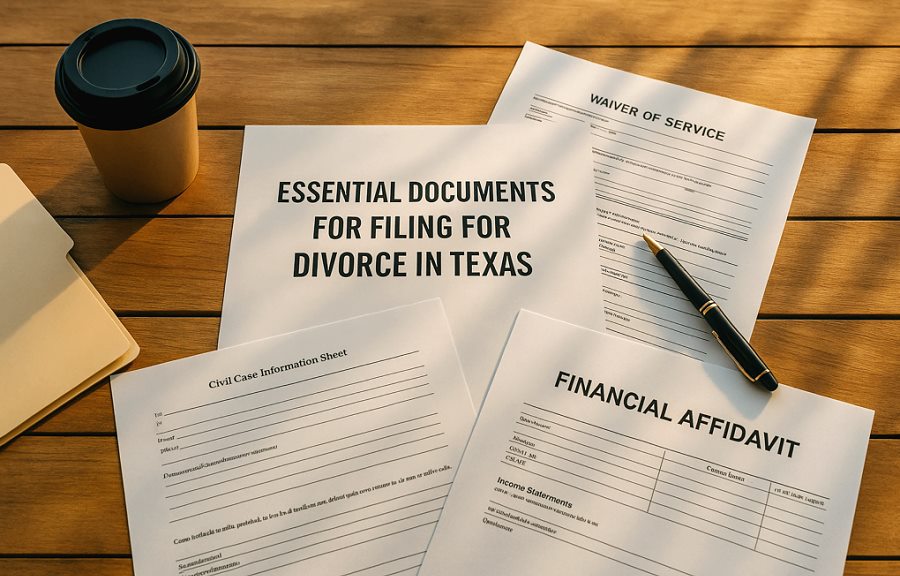
In Texas, all divorces — whether contested or uncontested — must go through the district courts. The basic steps include:
- Filing an Original Petition for Divorce with the appropriate district court
- Serving the other spouse (or having them waive service)
- Observing the mandatory 60-day waiting period under Texas Family Code § 6.702
- Reaching an agreement on all divorce-related issues or attending a trial\
- Drafting and filing a Final Decree of Divorce signed by the judge
Each of these steps has procedural and legal requirements that, if not followed precisely, can delay your case, get your paperwork rejected, or result in a legally defective divorce decree.
When Might a DIY Divorce in Texas Be Feasible?
Let’s be honest: there are some limited circumstances where a pro se divorce may be manageable. These situations include:
- Short-term marriages (typically under 2–3 years) with no children
- No significant shared assets or debts — no real estate, no retirement accounts, no business interests
- Full agreement on all terms between both spouses before filing
- No history of domestic violence or significant power imbalances
- No spousal maintenance issues to negotiate
Even in these “simple” cases, the paperwork must be prepared and filed correctly under Texas law. One wrong checkbox, one missing exhibit, or one ambiguous clause in your Final Decree of Divorce can have lasting legal consequences.
The moment children are involved, significant assets are at stake, or disagreements exist on any issue, the risk of a costly pro se mistake rises dramatically.
The Most Common Pro Se Divorce Mistakes in Texas
1. Using Generic or Out-of-State Divorce Forms
One of the most frequent — and most damaging — mistakes Texans make in a DIY divorce is downloading generic divorce forms from the internet that are not tailored to Texas law. Texas has its own Family Code, its own community property rules, and its own court-specific requirements. Forms designed for California, Florida, or any other state are legally invalid in Texas courts.
Even within Texas, individual district courts sometimes have local rules about how paperwork must be formatted, what exhibits must be attached, and how documents must be filed. A Final Decree of Divorce that does not comply with local rules can be rejected by the court clerk — or worse, signed by a judge and later challenged as unenforceable.
What to do instead: Use forms from Texas Law Help (texaslawhelp.org), which are approved by the Texas Supreme Court. Better yet, have a licensed Texas family law attorney review your paperwork before filing.
2. Incorrectly Characterizing Community vs. Separate Property
Texas is one of only nine community property states in the U.S. Under the Texas Family Code, most property and debt acquired during the marriage is presumed to be community property — owned equally by both spouses. Separate property (assets owned before marriage, gifts, and inheritances) belongs solely to one spouse and is generally not subject to division.
Pro se filers routinely make serious errors in this area, including:
- Treating all assets as community property when some are actually separate
- Failing to trace separate property with proper documentation (bank records, deeds, inheritance records)
- Commingling separate and community property and not accounting for it in the decree
- Forgetting to address all debts, leaving one spouse legally responsible for the other’s obligations
- Incorrectly listing real estate or omitting it from the property division entirely
A poorly worded property division clause in your Final Decree of Divorce can be nearly impossible to fix after the judge signs it. Texas courts are very reluctant to revisit property division after a decree is entered, and the legal standard to do so is extremely high.
3. Failing to Properly Divide Retirement Accounts and Pensions
This is arguably the single most expensive mistake in pro se Texas divorces. Retirement accounts — 401(k)s, IRAs, military pensions, government pensions, and defined benefit plans — accumulated during a marriage are community property in Texas. Many self-represented filers either:
- Simply agree verbally that each spouse “keeps their own” retirement, without understanding that the other spouse may have a valid community property claim to a portion
- Fail to draft and file a Qualified Domestic Relations Order (QDRO), which is a separate legal order required to actually divide most employer-sponsored retirement plans
- Attempt to write retirement account division language directly into the Final Decree without understanding that the plan administrator requires a separate QDRO
A QDRO is a highly technical document that must comply with both the divorce decree and the specific plan’s requirements. Many pro se filers discover — sometimes decades later when they retire — that the retirement accounts they believed were settled were never properly divided. By then, it is often too late to correct.
4. Child Custody and Parenting Plan Mistakes
If your divorce involves children, the stakes of getting it wrong cannot be overstated. Texas uses the terms conservatorship (legal decision-making authority) and possession and access (physical time with the child) rather than “custody” and “visitation.” Pro se filers frequently make critical errors, including:
- Using vague or ambiguous language in parenting plans (e.g., “reasonable visitation” without defined schedules) that leads to future conflicts
- Failing to include a Standard Possession Order or deviation from it without court-approved justification
- Not addressing holiday schedules, school breaks, birthdays, and extracurricular activities
- Overlooking geographic restrictions on where the primary parent can relocate with the child
- Failing to address decision-making authority on medical, educational, and religious matters
- Not understanding Texas’s “best interest of the child” standard and how courts evaluate it
Texas courts take child custody matters extremely seriously. Judges review parenting plans carefully, and a plan that fails to meet the child’s best interests will not be approved. If your plan contains gaps or errors, you may find yourself back in court — paying attorney’s fees for disputes that a properly drafted decree would have prevented.
5. Child Support Calculation Errors
Texas child support is calculated under a specific statutory formula set out in the Texas Family Code §§ 154.121–154.131. The formula is based primarily on the paying parent’s net monthly income and the number of children being supported. Common pro se errors include:
- Miscalculating net resources (gross income minus specific allowed deductions)
- Failing to account for health insurance obligations and medical support
- Not addressing extraordinary expenses such as private school tuition or special needs costs
- Setting child support at an amount below the Texas guidelines without proper deviation findings
- Forgetting to include provisions for annual review or modification triggers
Courts will not automatically approve a child support amount that deviates from the statutory guidelines without findings explaining why the deviation serves the child’s best interests. A pro se filer who submits an incorrect amount risks having the decree rejected — or worse, being bound to a legally unenforceable figure.
6. Missing the Service Requirements
After you file your Original Petition for Divorce, Texas law requires that your spouse be formally notified of the lawsuit. This is called service of process, and it must be done properly under the Texas Rules of Civil Procedure. Pro se filers often:
- Attempt to serve their spouse themselves (which is not allowed — the petitioner cannot serve the respondent)
- Fail to use a licensed process server or the county constable/sheriff
- Miss the requirements for waiver of service, which must be signed before a notary and meet specific statutory language requirements
- Do not understand what to do if a spouse cannot be located (citation by publication)
Improper service can render your entire divorce proceeding void. A judge cannot grant a divorce if the court does not have proper jurisdiction over both parties.
7. Drafting an Ambiguous or Incomplete Final Decree of Divorce
The Final Decree of Divorce is the single most important document in your divorce. It governs your legal rights and obligations for years — sometimes decades — after the divorce is finalized. Yet this is the document pro se filers most often get wrong.
Common drafting errors include:
- Failing to specifically identify and assign every piece of community property and debt
- Using vague language that is subject to multiple interpretations
- Omitting required statutory language (e.g., the IT IS ORDERED AND DECREED language required for enforceability)
- Failing to include a proper Mediated Settlement Agreement (MSA) if one was used
- Not attaching required exhibits (e.g., real estate legal descriptions, QDRO language)
- Leaving out provisions for name restoration if the spouse wants to return to a maiden name
An ambiguous decree leads to enforcement disputes, contempt proceedings, and return trips to court — all of which cost significantly more than hiring an attorney in the first place.
8. Not Understanding the 60-Day Waiting Period — And Other Timing Rules
Texas law imposes a mandatory 60-day waiting period from the date the Original Petition for Divorce is filed before a judge can grant the divorce. There is no way to waive this period except in cases involving family violence. Pro se filers sometimes:
- Attempt to finalize the divorce before the 60 days have elapsed
- Do not account for the time needed for service, the court’s docket, and hearing scheduling
- Miss deadlines for responsive pleadings if they are the respondent
Understanding how your local district court schedules uncontested divorce hearings — and what documents must be ready at that hearing — is critical to moving your case forward efficiently.
The Hidden Cost of a “Free” DIY Divorce
Many people pursue a pro se divorce to save money. But the financial analysis often misses the long-term picture. Consider:
- A failure to properly divide a retirement account could cost you tens of thousands of dollars in lost community property
- An ambiguous custody order that requires litigation to interpret can cost $5,000 to $20,000 or more in attorney’s fees
- Incorrect property division that requires post-decree modification involves court filings, hearings, and attorney’s fees
- Some pro se divorce mistakes cannot be corrected at all after the decree is signed
The upfront cost of hiring a family law attorney is almost always significantly less than the cost of fixing a pro se mistake — assuming it can be fixed.
When You Absolutely Need a Texas Family Law Attorney
You should strongly consider retaining a licensed Texas family law attorney any time your divorce involves:
- Children — custody, conservatorship, possession and access, or child support
- Real estate — a marital home, rental properties, or land
- Retirement accounts or pensions of any kind
- Business interests owned by either spouse
- Significant debts, including mortgages, car loans, credit cards, or business liabilities
- Domestic violence or a significant power imbalance
- Disagreements on any issue between the spouses
- Military service by either spouse (military divorces have unique federal law considerations)
- Spousal maintenance (alimony) claims
Even in cases that appear simple, a one-time consultation with a family law attorney can help you understand what you may be overlooking and whether your paperwork is legally sound.
How Barton & Associates Can Help With Your Texas Divorce
At Barton & Associates, Attorneys at Law, our San Antonio family law team has helped hundreds of clients navigate Texas divorce proceedings — from straightforward uncontested divorces to complex high-asset and high-conflict cases. We understand that every client’s situation is different, and we tailor our approach to meet your specific needs and goals.
Whether you are considering a pro se divorce and want a professional review of your paperwork, or you need full representation through every step of the process, we are here to protect your rights and your future.
We handle all aspects of Texas divorce, including:
- Uncontested and contested divorce
- Property and debt division
- Child custody and conservatorship
- Child support calculation and enforcement
- Spousal maintenance
- QDROs and retirement account division
- High-net-worth and high-conflict divorce
- Post-divorce modifications and enforcement
Contact Barton & Associates Today
If you are considering a DIY divorce in Texas — or if you have already filed pro se and are worried about mistakes — do not wait to get legal guidance. The sooner you consult with a qualified Texas family law attorney, the more options you will have. Contact Barton & Associates today at 210-500-0000 or complete our online Free Consultation form.