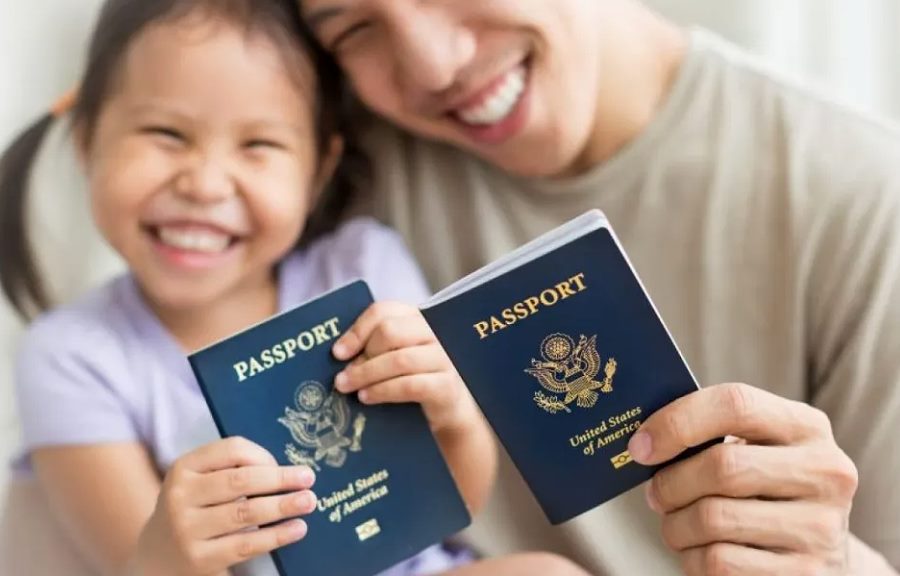
Can My Ex Take Our Kids Abroad? Texas Custody Passport Rules
If your ex has family abroad, travels internationally for work, or you’re simply worried about your child leaving the country without your knowledge, understanding exactly how passport rules and international travel actually work with your San Antonio divorce with children lawyer in a Bexar County Divorce With Kids case can turn a vague fear into something you can genuinely act on.
The Federal Two-Parent Rule
Here’s the foundation to understand first: for a child under 16, obtaining a U.S. passport generally requires both parents’ or legal guardians’ consent — this is a federal rule, not something that depends on your specific Texas custody order. If one parent can’t appear in person with the child at the passport application, that parent has to complete a notarized Statement of Consent (Form DS-3053). This form has to actually be signed in front of a notary; a signature merely witnessed by a friend, relative, or even the passport acceptance agent isn’t accepted.
If the applying parent genuinely can’t locate or reach the other parent at all, a different form applies — the Statement of Exigent/Special Family Circumstances (DS-5525) — which requires demonstrating that two-parent consent is truly unobtainable, not simply inconvenient.
The Distinction That Trips Up a Lot of Parents
This is worth understanding precisely, because it’s a common point of confusion: the two-parent-consent requirement can be bypassed with a court order — but only if that order grants sole legal custody, not joint custody. If you and your ex share joint managing conservatorship, which is the default arrangement in most Texas custody cases, one of you generally cannot obtain a passport for your child without the other’s consent, even if you’re the parent with the exclusive right to designate the child’s primary residence. Sole legal custody and the right to designate primary residence are not the same thing, and only genuine sole custody allows this bypass.
A Real Tool to Protect Your Child: CPIAP
Beyond understanding the consent rules, there’s a genuinely useful, free preventive tool worth knowing about: the Children’s Passport Issuance Alert Program, or CPIAP, run directly by the U.S. Department of State. Enrolling your child — using Form DS-3077, along with proof of your identity and your legal relationship to the child — adds them to the State Department’s Passport Lookout System. If anyone later applies for a passport for your enrolled child, you’re contacted directly and generally given about 30 days to respond before the application proceeds.
It’s important to understand with a San Antonio divorce lawyer honestly what CPIAP does and doesn’t do. It provides an alert and a window to respond — it does not guarantee that a passport application will be blocked. If the legal requirements for issuance are otherwise met, a passport can still be issued even with CPIAP active. It’s also worth knowing that CPIAP doesn’t revoke a passport your child already has, and it has no control over a foreign country’s own passport process for a child who holds dual citizenship. CPIAP is a genuinely valuable early-warning tool, not an absolute guarantee.
The Strongest Protection: Specific Language in Your Custody Order
Given these real limitations, the most reliable protection generally comes from the custody order itself. A Texas custody order can include specific provisions addressing international travel directly — requiring both parents’ written consent before any international trip, mandating advance notice with detailed itineraries, requiring a bond or other security before travel to a country of particular concern, or restricting travel to countries that aren’t parties to the Hague Convention on the Civil Aspects of International Child Abduction. This is a different, more specific protection than the general domestic geographic restriction that addresses where a child’s primary residence can be — our companion guide on relocation and geographic restrictions covers that separate issue.
What This Means for Your Bexar County Custody Case
If international travel is a genuine concern in your case — because of family ties abroad, a parent’s citizenship, or simply a breakdown in trust — this is worth raising directly and specifically during your custody negotiations, rather than relying on the general federal consent rule alone. Enrolling your child in CPIAP costs nothing and adds a real layer of protection, but the strongest, most reliable safeguard is specific, well-drafted language built directly into your custody order.
Frequently Asked Questions
Q: Can my ex get our child a passport without my permission?
A: Generally, no, if your child is under 16 and neither of you has sole legal custody. Both parents’ consent is required under federal rules, with narrow exceptions for a parent who genuinely cannot be located.
Q: Does having primary custody mean I can get a passport without my ex’s consent?
A: Not necessarily. The bypass for two-parent consent generally requires sole legal custody specifically — having the right to designate your child’s primary residence under a joint conservatorship arrangement is not the same thing.
Q: What is CPIAP and should I enroll my child?
A: CPIAP is a free State Department program that alerts you if anyone applies for a passport for your enrolled child, giving you roughly 30 days to respond. It’s a genuinely useful early-warning tool, though it doesn’t guarantee an application will be blocked.
Q: What if my child already has dual citizenship and a foreign passport?
A: This is an important limitation to understand — CPIAP has no control over a foreign country’s own passport issuance process, so a foreign passport could potentially still be obtained outside CPIAP’s reach. This is worth discussing directly with your divorcing parents lawyer in San Antonio if it applies to your situation.
Q: Can I put specific international travel restrictions in my custody order?
A: Yes. Texas custody orders can include specific provisions addressing international travel, including required consent, advance notice, or restrictions related to specific countries. This is generally the strongest protection available and is worth raising directly during your case.
Schedule a Free Consultation
Barton & Associates, Attorneys at Law
115 Camaron St, San Antonio, TX 78205
Office: 210-500-0000
Division: Family Law San Antonio
Practice Area: Divorce & Separation
Focus Area: Divorce With Kids