San Antonio Trespassing Defense Lawyers – Protecting Your Rights Against Trespass Charges
Understanding the Serious Nature of Criminal Trespass in Texas
When most people hear the word “trespassing,” they picture a minor offense—perhaps a warning from a security guard to leave private property. However, under Texas law, criminal trespass is a serious criminal charge that can result in jail time, substantial fines, and a permanent criminal record. At Barton & Associates, our experienced Texas criminal defense attorneys understand that these charges often stem from misunderstandings, poor signage, or a simple lack of awareness that you were on private property. A trespassing conviction is not a simple citation; it is a criminal misdemeanor that can affect employment opportunities, housing applications, professional licenses, and your personal reputation for years to come. If you or a loved one is facing trespassing charges, it is critical to understand the law and secure aggressive legal defense immediately.
What Constitutes Criminal Trespass Under Texas Law?
Texas Penal Code § 30.05 defines criminal trespass as entering or remaining on another person’s property without effective consent, and with notice that entry was forbidden. The legal definition hinges on several key elements that the prosecution must prove beyond a reasonable doubt.
The Three Critical Elements of a Trespass Charge:
- Entry or Remainder on Property: This includes not only entering a building but also remaining on any land, including open fields, ranches, fenced areas, or commercial premises.
- Lack of Effective Consent: You did not have permission from the owner or legal possessor of the property to be there. Consent can be withdrawn at any time, and remaining after being asked to leave constitutes trespass.
- Notice That Entry Was Forbidden: This is often the most contested element. Notice can be given in several ways:
- Oral or Written Communication: Directly from the owner or someone with apparent authority (e.g., a manager, security guard).
- Fencing or Enclosures: Clearly marked fencing that encloses the property.
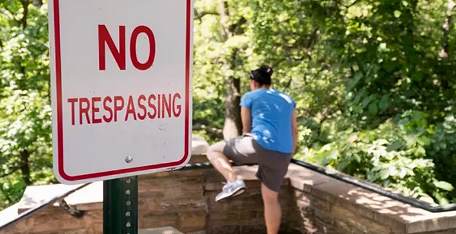
- Posted Signs: Signs that are reasonably likely to come to the attention of an intruder, containing specific language outlined in the law (typically “No Trespassing”).
- Purple Paint Marks: Unique to Texas, bright purple paint marks on trees or posts serve as legal notice equivalent to a “No Trespassing” sign. The marks must be vertical lines at least 8 inches long and between 3 and 5 feet from the ground.
Common Scenarios Leading to Trespass Charges:
- Remaining on Commercial Property after being asked to leave by store management or security.
- Entering a Construction Site or vacant property out of curiosity, regardless of intent to steal.
- Hunting or Fishing on Private Land without explicit permission from the landowner.
- Entering a Former Partner’s Residence after being told not to return, even if you previously lived there.
- Attending a Party or Event on private property after the host has revoked your invitation.
- Ignoring “No Trespassing” Signs while hiking, exploring, or taking shortcuts.
The Severe Penalties for a Trespassing Conviction
The penalties for criminal trespass in Texas escalate based on the type of property involved and the defendant’s intent or prior history.
Standard Criminal Trespass (Most Cases):
- Class B Misdemeanor
- Up to 180 days in county jail
- Fine of up to $2,000
Enhanced Trespass Charges:
- Class A Misdemeanor (Up to 1 year in jail, $4,000 fine) applies if:
- The trespass occurs on a “superfund” site (a designated hazardous waste area).
- The trespasser carries a deadly weapon during the offense.
- The trespass occurs on agricultural land and causes damage exceeding $100.
- State Jail Felony (180 days to 2 years in state jail, $10,000 fine) applies if:
- The trespass occurs on “critical infrastructure” such as a gas refinery, chemical plant, or water treatment facility.
- The trespass occurs on the habitation or shelter of another person and is intended to commit a separate felony.
Collateral Consequences Beyond the Courtroom:
- Permanent Criminal Record: A misdemeanor conviction appears on background checks conducted by employers, landlords, and licensing boards, often leading to automatic disqualification.
- Employment Difficulties: Jobs in security, education, government, and many corporate settings become difficult or impossible to obtain.
- Housing Challenges: Landlords routinely deny applications from individuals with criminal records.
- Professional Licensing Issues: Licenses for nursing, real estate, law, and other regulated professions can be denied or revoked.
- Damage to Personal Reputation: The stigma of a criminal conviction can strain personal relationships and community standing.
Key Defense Strategies for Trespassing Charges
At Barton & Associates, we build defenses by attacking the core elements of the prosecution’s case. Every situation is unique, but successful defense strategies often include:
- Challenging the Element of Notice: This is the most common and effective defense. We investigate whether “No Trespassing” signs were properly posted, visible, and contained the legally required language. Were purple paint marks correctly applied and visible? Was any oral notice actually given, and by someone with proper authority?
- Asserting a Claim of “Effective Consent”: You may have believed you had permission to be on the property. We present evidence of an implied invitation (e.g., an open gate, business hours), a prior relationship with the owner, or a reasonable mistake of fact about property boundaries.
- Lack of Criminal Intent: Trespass requires a knowing or reckless mental state. We demonstrate that you had no intent to violate the law—you were lost, disoriented, believed it was public property, or entered to seek emergency assistance.
- Questioning the Evidence of Entry: Can the prosecution definitively prove you were the individual on the property? We challenge vague witness descriptions, unclear surveillance footage, and unreliable identification procedures.
- Constitutional Defenses: If you were arrested without probable cause or evidence was obtained through an unlawful search, we file motions to suppress that evidence, which can lead to a case dismissal.
The Critical Importance of Early Legal Intervention
If you are under investigation or have been charged with trespassing, the actions you take in the first few days are crucial.
- Do Not Discuss the Case. Do not speak to property owners, security personnel, or law enforcement about the incident without an attorney present. Anything you say can be twisted and used against you.
- Document Everything. Write down a detailed account of what happened while your memory is fresh. Note the location, time, visibility of any signs, what was said to you, and why you were on the property.
- Take Photographs. If possible and safe, return to the area (without trespassing again) to photograph the property lines, signage, gates, and any relevant landmarks that show your perspective.
- Contact a Defense Attorney Immediately. Early involvement by our firm allows us to protect your rights from the start. We can often intervene before formal charges are filed, communicate with prosecutors on your behalf, and begin building your defense while evidence is fresh.
Why Choose Barton & Associates for Your Trespassing Defense
Facing a trespassing charge requires a law firm that understands both the letter of the law and the practical realities of how these cases are prosecuted in Texas courts.
- Former Prosecutorial Insight: Our attorneys include former prosecutors who know exactly how the state builds trespassing cases. We understand their strategies and can anticipate their arguments, allowing us to develop more effective counter-strategies.
- Aggressive and Strategic Defense: We are trial-ready litigators. We prepare every case thoroughly, which gives us significant leverage in negotiations. We fight for dismissals, charge reductions, and alternative resolutions like pre-trial diversion or deferred adjudication to keep your record clean.
- Compassionate, Client-Focused Representation: We understand the anxiety and embarrassment a criminal charge can cause. You will work directly with your attorney, who will guide you through each step, explain all options clearly, and fight for the best possible outcome.
- Deep Knowledge of Texas Property Law: Our experience extends beyond criminal statutes to include relevant property law, understanding of signage requirements, and familiarity with local ordinances that can impact your case.
Protect Your Future Today: Contact Our Texas Trespassing Defense Attorneys
A trespassing conviction is more than an inconvenient mark on your record—it is a barrier to opportunities and a burden on your future. Do not make the mistake of assuming the charge is minor or that you can handle it alone. The legal system is complex, and prosecutors are not on your side.
Take the first step toward protecting your rights. Contact Barton & Associates today at 210-500-0000 for a confidential and thorough case evaluation. We will listen to your story, explain the charges and potential defenses in clear terms, and immediately begin building a powerful defense strategy designed to secure the best possible outcome for you.
Main Category: Criminal Defense
Practice Area Category: Misdemeanors
Barton & Associates, Attorneys at Law
115 Camaron St, San Antonio, TX 78205
Office: 210-500-0000